

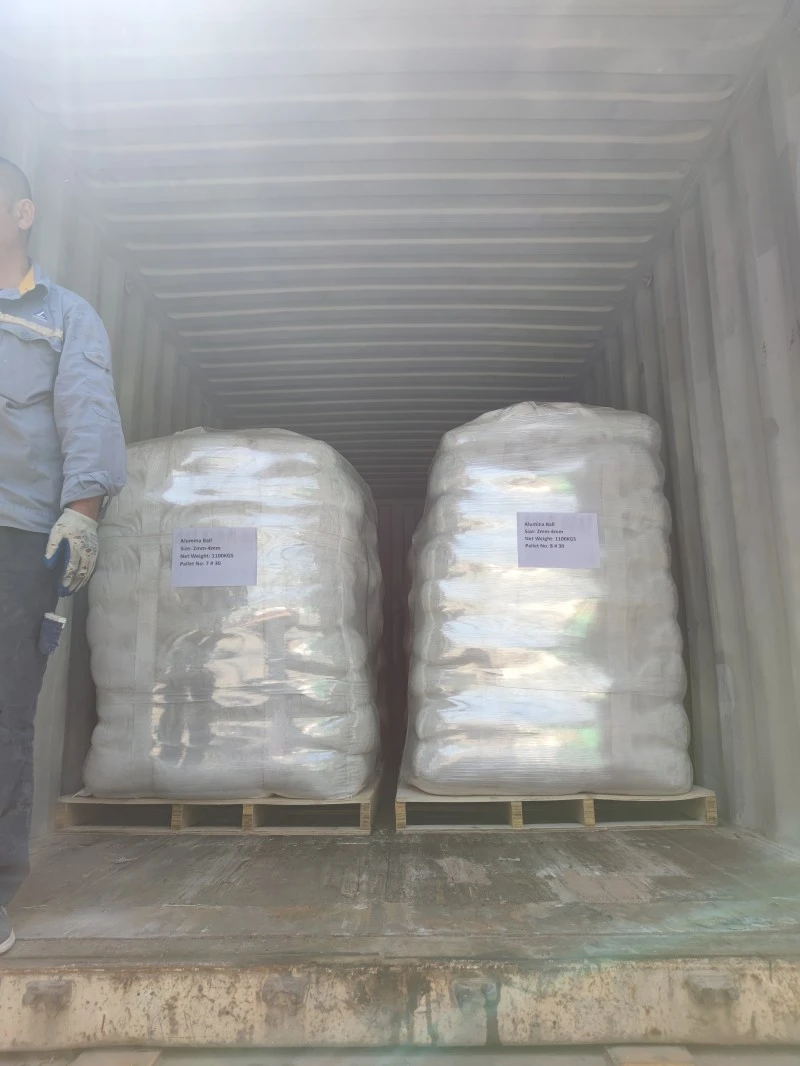
33 tons of activated alumina balls being loaded for shipment abroad

Activated alumina ball Products:

|
Type |
EniSorb Activated Alumina Adsorbent |
|||||
|
|
A01 |
A02 |
A03 |
A04 |
A05 |
|
|
Application |
Gas, fluid Drying |
Fluoride Removal |
H2O2 Production |
Catalyst Carrier |
Air Dryer |
|
|
Appearance |
White sphere, Insoluble in water, Innocuous |
|||||
|
Crystal Type |
x-p |
x-p |
y |
y |
x-p |
|
|
Composition (%) |
Al2O3 |
≥93.5 |
≥93.5 |
≥93.5 |
≥93.5 |
≥93.5 |
|
Na2O |
≤0.3 |
≤0.3 |
≤0.3 |
≤0.3 |
≤0.3 |
|
|
Fe2O3 |
≤0.2 |
≤0.2 |
≤0.2 |
≤0.2 |
≤0.2 |
|
|
SiO2 |
≤0.2 |
≤0.2 |
≤0.2 |
≤0.2 |
≤0.2 |
|
|
LOI (%) |
4-7 |
4-7 |
4-7 |
4-7 |
4-7 |
|
|
Bulk Density (g/ml) |
0.68~0.72 |
0.70~0.75 |
0.70~0.80 |
0.50-0.70 |
0.68-0.75 |
|
|
Surface Area (m2/m3) |
300-350 |
300-350 |
300-350 |
300-350 |
300-350 |
|
|
Pore Volume (ml/g) |
0.45-0.50 |
0.45-0.50 |
0.45-0.50 |
0.45-0.50 |
0.45-0.50 |
|
|
Water Adsorption % |
17-20 |
Fluoride 2.5-4 |
- |
- |
17-20 |
|
|
Active (%) |
-- |
-- |
56~62 |
-- |
-- |
|
|
Attrition Loss |
≤1.0 |
≤1.0 |
≤1.0 |
≤0.4 |
≤0.8 |
|
|
Crushing Strength (N/pc) |
1-3mm |
≥50 |
≥50 |
≥50 |
≥50 |
≥50 |
|
3-5mm |
≥150 |
-- |
≥150 |
≥150 |
≥150 |
|
|
4-6mm |
≥180 |
-- |
≥180 |
≥180 |
≥180 |
|
|
5-7mm |
≥250 |
-- |
≥250 |
≥250 |
≥250 |
|
|
6-8mm |
≥300 |
-- |
-- |
≥300 |
≥300 |
|
|
8-10mm |
≥450 |
-- |
-- |
≥450 |
≥450 |
|
|
12-14mm |
≥500 |
-- |
-- |
≥500 |
≥500 |
|
1. What are activated alumina balls?
Activated alumina balls are a solid material with a porous structure, a high specific surface area, and high adsorption activity. They are typically manufactured as white or reddish spherical particles, hence the name.
You can think of them as very dry "ceramic balls" riddled with tiny pores. These countless micropores give them an enormous surface area (one gram of activated alumina can have a surface area of hundreds of square meters, equivalent to the size of a basketball court), enabling them to efficiently capture and adsorb a wide range of substances.
2. What are their uses?
The core properties of activated alumina balls are their strong adsorption, high surface activity, and excellent thermal stability. These properties give rise to a wide range of applications, including the following:
1. Adsorbent - The Main Application
This is the most classic application of activated alumina, leveraging its large surface area and hydrophilic properties to adsorb substances.
Deep drying of gases and liquids: This is its most widespread application. It effectively adsorbs water molecules and is used for deep drying of compressed air, industrial gases (such as hydrogen, oxygen, nitrogen, and natural gas), cracked gas, ethylene, propylene, and other gases, reducing their dew points to below -70°C.
For example, in compressed air systems, compressed air contains a large amount of water vapor. If not removed, it can corrode pneumatic tools and equipment. Activated alumina desiccant is the core filler in compressed air dryers.
Defluoridation of drinking water: In areas with high fluoride content, activated alumina can be used to defluoride drinking water, preventing dental fluorosis and skeletal fluorosis, making it an important water treatment material.
Industrial wastewater treatment: It can adsorb and remove heavy metal ions (such as arsenic and lead) and phosphorus from water, among other pollutants.
2. Catalyst Support
Due to its high surface area and stable physical properties, activated alumina spheres are extremely important and commonly used catalyst supports in the chemical industry.
Purpose: They support precious metals (such as platinum, palladium, and rhodium) or other active catalytic components on their large surface area, providing maximum contact area for reaction, thereby improving catalytic efficiency and saving catalyst usage.
Applications: They are widely used in petroleum refining (such as catalytic cracking and hydrotreating), automobile exhaust purification (three-way catalytic converters), and chemical synthesis (such as fertilizer and plastic manufacturing).
3. Catalysts
In certain chemical reactions, activated alumina itself can directly act as a catalyst.
Applications: For example, in the petroleum industry, it is used in olefin isomerization reactions and alcohol dehydration reactions.
4. Selective Adsorption
Utilizing its surface properties, it can selectively adsorb specific molecules.
Application: In the petroleum industry, it is used for the selective adsorption of sulfides from mixed hydrocarbons; used as an adsorbent in chromatographic analysis, etc.


