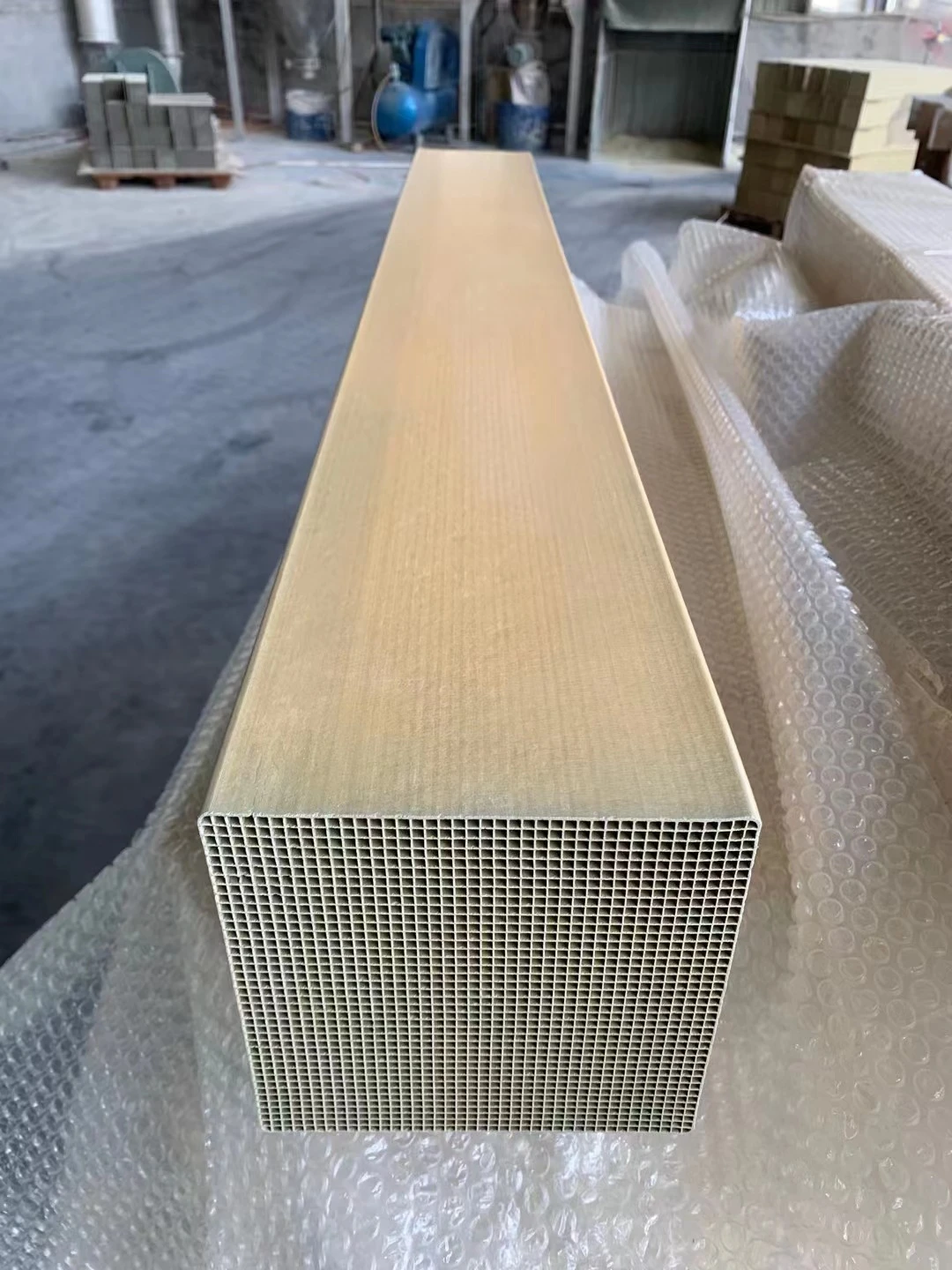
A denitration catalyst is a core component used in power plant SCR systems. It facilitates the selective chemical reaction between a reducing agent and nitrogen oxides in flue gas. The most prevalent commercial formulation is the V₂O₅-WO₃(MoO₃)/TiO₂ series, where TiO₂ acts as the primary carrier and V₂O₅ is the main active component.

Main Catalyst Types and Their Construction
There are three primary structural types of SCR catalysts, each with distinct manufacturing processes:
Plate-type: Built on a stainless-steel mesh substrate coated with a mixture of TiO₂ and V₂O₅, then pressed and sintered into modules.
Honeycomb-type: This homogeneous catalyst is manufactured by extruding a mixture of TiO₂, V₂O₅, and WO₃ through ceramic equipment. It is produced as elements with a standard cross-section (e.g., 150mm x 150mm) and assembled into larger modules. At Zhongci, our expertise as a ceramic manufacturer positions us as a key supplier of these high-performance honeycomb catalysts.
Corrugated Plate-type: Typically uses a fiberglass-reinforced TiO₂ base, with active components like WO₃ and V₂O₅ impregnated onto its surface.
Design Focus: Performance and Ash Fouling Resistance
The catalyst is the heart of the SCR system, determining its efficiency and economics. A key design challenge is ensuring long-term resistance to ash fouling and abrasion in variable flue gas conditions.
Comparing the three types: plate catalysts offer the largest open area (>85%), making them most resistant to plugging. Honeycomb catalysts have a moderately high open area (~80%). While their 90-degree angles can be prone to ash bridging, selecting a larger pitch design can significantly improve anti-clogging performance, making it comparable to plate types. Corrugated plates generally have the smallest angles and are most susceptible to ash accumulation.
Why Partner with Zhongci for Your Catalyst Needs
Choosing the right catalyst structure and formulation is critical for system longevity. Pingxiang Zhongci Environmental Ceramics Material Co., Ltd. leverages its specialized background in advanced ceramic manufacturing to produce durable and efficient catalyst solutions.
Focused Expertise: Our core competency in developing and extruding ceramic materials translates directly into producing robust honeycomb catalysts designed for stable performance.

Technical Application Support: We provide more than just products. Our team can advise on selecting the optimal catalyst pitch and geometry to balance activity with fouling resistance for your specific operating conditions.
Reliable Module Supply: We supply finished, high-quality catalyst modules ready for installation, ensuring consistency and reliability.
For applications involving high-temperature flue gas, our specialized High Temperature SCR Denitration Catalyst is engineered to combat thermal deactivation. Utilizing a cordierite carrier, it maintains activity in demanding conditions from 300°C to 550°C, a common range where standard catalysts may sinter and degrade.
learn more about us product>>>>>
Looking for a knowledgeable partner for your SCR catalyst project?
Contact us to discuss how our catalyst solutions can be tailored to meet the efficiency and durability demands of your system.